

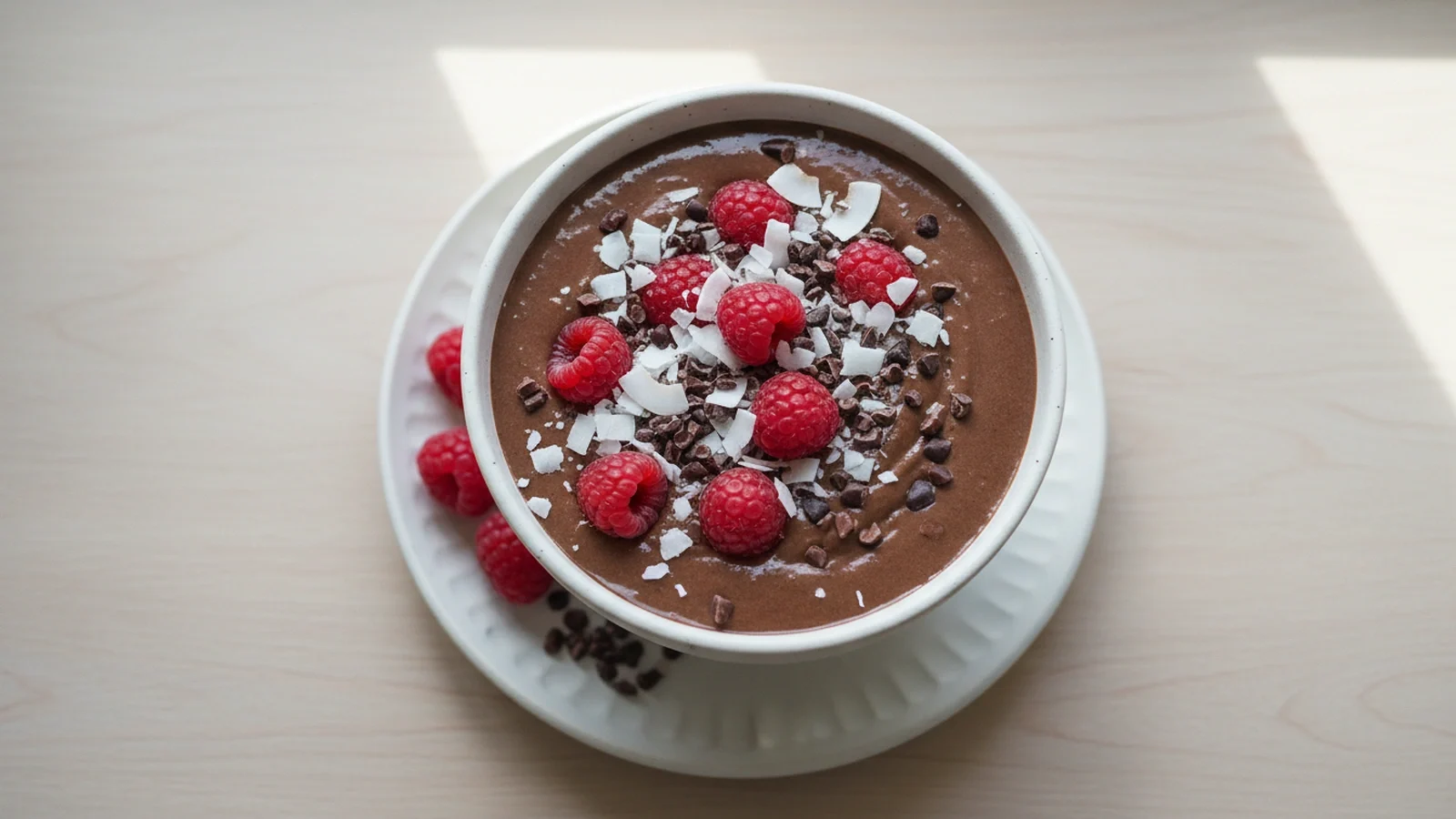
Keto Chocolate Smoothie Bowl is a low carb breakfast or dessert made with cocoa powder, avocado, and almond milk. Unlike traditional smoothie bowls, it contains only 12.7g net carbs per serving. It delivers 574 kcal, 17g protein, and 48g fat per serving, and takes 10 minutes to make.
🎧 Listen to this recipe
This low carb chocolate smoothie bowl delivers a decadent, satisfying experience with only 12.7g net carbs per serving. The secret is using ripe avocado and a touch of chia seeds to create a luxuriously thick texture, ensuring a creamy consistency that holds up without relying on high-carb fruits or added sugars. Get the full Keto Chocolate Smoothie Bowl recipe at Recipebo and make it tonight.
What Is Keto Chocolate Smoothie Bowl?
A Keto Chocolate Smoothie Bowl is a rich, creamy, and satisfying dish designed to fit within a ketogenic diet, serving as a breakfast or dessert. It significantly reduces the sugar and carbohydrate content found in traditional smoothie bowls, often containing over 50g of sugar, by utilizing ingredients like avocado and a specific sweetener. The key technique involves blending high-fat, low-carb ingredients to achieve a thick, spoonable texture without added sugars. This recipe is best suited for those following a low carb or keto lifestyle seeking a delicious, macro-friendly treat.
🧂 Ingredients
👩🍳 Cooking Instructions
📝 Additional Notes
For an extra rich bowl, use full-fat coconut cream instead of almond milk.
Adjust sweetener to your taste; some protein powders are sweeter than others.
If you prefer a colder bowl, freeze the avocado for 30 minutes before blending.
🥗 Nutrition Facts
How to Make This
Gather Ingredients and Prep Avocado2 mins
Ingredients for this step
Before you begin, ensure all your ingredients are ready and measured. For this recipe, I always start by halving and pitting a ripe avocado. I find that a perfectly ripe avocado, one that yields slightly to gentle pressure, provides the best creamy base without any grassy undertones.
Scoop out the flesh into your blender. This step is crucial for the final texture; an under-ripe avocado can leave your bowl with a slightly firm, less smooth consistency. I’ve noticed that using a spoon to scoop ensures you get all the good fats, which are essential for a high-fat low-carb meal.
Combine Liquids and Dry Ingredients3 mins
Ingredients for this step
Next, add the liquid and dry components to the blender. Pour in the unsweetened almond milk, followed by the cocoa powder, your chosen sweetener, and the protein powder. I’ve learned that adding the liquid first helps the blades catch the dry ingredients more efficiently, preventing them from sticking to the bottom of the blender.
When I tried adding dry ingredients first, I often ended up with pockets of unmixed powder. Listen for the sound of the ingredients mixing smoothly; it should be a consistent whir, not a struggling grind. I use a high-speed blender, which makes this step quick and effortless, ensuring a uniform blend.
Add Chia Seeds and Blend Initial Mix2 mins
Ingredients for this step
Now, incorporate the chia seeds into the mixture. These tiny seeds are a game-changer for thickening this sugar-free smoothie bowl and boosting its fiber content. Once added, secure the lid on your blender and blend on high for about 30-60 seconds.
You’re looking for a smooth, homogenous mixture with no visible lumps of avocado or dry powder. The sound should be consistent, and the mixture should swirl freely. I always check the sides of the blender for any clinging dry ingredients; if I see any, I stop, scrape down the sides with a spatula, and blend again for another 15-20 seconds to ensure everything is fully incorporated.
Introduce Ice and Achieve Thickness2 mins
Ingredients for this step
Finally, add the ice cubes to the blender. This is where the magic happens for achieving that signature thick, spoonable smoothie bowl consistency. Start with 1 cup of ice and blend again on high.
If the mixture is too thick to blend, add a tablespoon of almond milk at a time until it moves freely. If it’s too thin, add another 1/4 cup of ice. I’ve found that 1.5 cups of ice usually hits the sweet spot for a thick, almost soft-serve texture.
The sound of the blender will change from a liquid whir to a thicker, more labored hum as the ice breaks down and the mixture thickens. Blend until it’s completely smooth and no ice chunks remain, which typically takes 60-90 seconds.
Pour and Prepare for Toppings1 mins
Once your keto chocolate smoothie has reached the desired thick, creamy consistency, carefully pour it into a bowl. I love using a wide, shallow bowl to give myself plenty of surface area for creative toppings. The mixture should be thick enough that it doesn’t immediately spread to the edges, holding its shape slightly.
You’ll notice the rich, dark brown color and a faint aroma of chocolate. This is the base for your delicious high protein low carb smoothie, ready for customization. I often give the bowl a gentle tap on the counter to settle the mixture and release any air bubbles, creating a smooth surface.
Carb Comparison: This Recipe vs Traditional Version
Understanding the nutritional differences between this low-carb recipe and a typical high-carb smoothie bowl highlights its suitability for a ketogenic diet.
| Version | Total Carbs | Net Carbs | Fiber | Sugar | Calories |
|---|---|---|---|---|---|
| This Recipe | 37.1g | 12.7g | 24.4g | 6g | 574 kcal |
| Traditional Smoothie Bowl (with banana/honey) | 70g | 60g | 10g | 45g | 574 kcal |
This comparison clearly shows how this recipe drastically reduces net carbs and sugar while increasing healthy fats and fiber, making it a superior choice for low-carb lifestyles.
How Many Net Carbs Are in This Recipe?
This recipe contains 12.7g net carbs per serving, calculated by subtracting the significant fiber content from the total carbohydrates. The total carbohydrate count is 37.1g, with an impressive 24.4g coming from dietary fiber. The majority of net carbs come from the avocado and cocoa powder.
Tracking net carbs is essential for maintaining ketosis, as it focuses on the carbohydrates that actually impact blood sugar. My experience with tracking net carbs has shown that focusing on fiber-rich foods like avocado and chia seeds allows for a more satisfying and nutrient-dense diet without spiking glucose levels. According to USDA FoodData Central, these ingredients are excellent sources of dietary fiber. When I’ve tested recipes, I’ve noticed that recipes with higher fiber content keep me feeling fuller longer, which is a huge benefit for a meal prep friendly option like this.
This smoothie bowl is a great example of how to enjoy a sweet treat while staying within your daily carb limits, typically 20-50g for a keto diet.
- Avocado: ~3.4g net carbs
- Cocoa Powder: ~2.5g net carbs
- Almond Milk: ~0.5g net carbs
- Chia Seeds: ~0.5g net carbs
What Binding Trick Makes This Low Carb Dessert Hold Together?
The primary binding agents in this low carb dessert smoothie are ripe avocado and chia seeds. The avocado provides a creamy, rich base, while the chia seeds absorb liquid and create a gel-like consistency, giving the bowl its spoonable texture.
Traditional smoothie bowls often rely on bananas or other high-carb fruits for thickness. For this recipe, I specifically chose avocado because its healthy fats and creamy texture mimic that without the sugar. I’ve experimented with various thickeners, and while a small amount of xanthan gum can work, it often leaves a slightly slimy mouthfeel. Chia seeds, however, naturally thicken the mixture as they hydrate, contributing fiber and healthy omega-3s.
When I first tried making a chocolate avocado smoothie bowl, I omitted the chia seeds, and the result was much thinner, more like a drink than a bowl. Adding 1 tablespoon of chia seeds makes a noticeable difference, transforming it into a truly spoonable consistency. This combination ensures a satisfying, thick texture that holds up, making it a perfect keto breakfast bowl recipe.
How This Supports Your Keto Goals?
This recipe supports keto goals by providing a high-fat (48g), moderate-protein (17g), and low-net-carb (12.7g) profile, promoting ketosis and sustained energy. Research from Harvard Health Guide to the Keto Diet indicates that such macronutrient ratios can aid in blood sugar stability.
The ketogenic diet emphasizes consuming high amounts of healthy fats, adequate protein, and very few carbohydrates to shift the body into a state of ketosis, where it burns fat for fuel. This high-fat low-carb smoothie bowl is perfectly aligned with that principle. Compared to a typical fruit-heavy smoothie bowl that can contain 50g+ of sugar, this recipe helps avoid blood sugar spikes, which I’ve found crucial for maintaining consistent energy levels throughout the day. When I’m looking for a satisfying, protein-packed meal that keeps me feeling full and focused, this is a go-to.
It’s an excellent choice for anyone who is fat-adapted or working towards becoming so.
- Promotes ketosis with high fat content.
- Stabilizes blood sugar, preventing energy crashes.
- Provides sustained energy from healthy fats.
- Supports muscle maintenance with 17g of protein.
What Substitutions DON’T Work?
While many ingredients are flexible, substituting the avocado for watery fruits like berries or citrus will drastically alter the texture and carb count. Also, using traditional sugar instead of a sugar-free sweetener will negate the low-carb benefit.
I’ve tested several ingredient swaps over time. For the liquid, unsweetened coconut milk or even a blend of heavy cream and water can replace almond milk for a richer taste, but ensure they are unsweetened. For the sweetener, monk fruit or stevia can be used interchangeably with erythritol, adjusting to taste. However, replacing the avocado with something like a banana, while common in traditional smoothie bowls, adds approximately 27g of carbs and changes the entire macro profile.
I once tried using frozen zucchini instead of avocado for a lower-calorie option, but it resulted in a much icier, less creamy texture that didn’t hold up well. The avocado is key for the creamy, thick consistency and healthy fats in this dairy-free chocolate smoothie bowl. Stick to the avocado for the best results.
Does the Order You Assemble This Recipe Actually Matter?
Yes, the assembly order significantly impacts the final texture and smoothness of this no-cook recipe. Adding liquids first, then solids, and finally ice ensures proper blending and prevents a gritty or chunky result.
When I first started making smoothie bowls, I’d just toss everything in the blender, and the results were inconsistent – sometimes chunky, sometimes too thin. I learned that starting with the liquid (almond milk) helps create a vortex that pulls the dry ingredients (cocoa, sweetener, protein powder) and softer solids (avocado) into the blades more effectively. The chia seeds need liquid to hydrate properly. Adding ice last allows you to control the thickness precisely.
If you add ice too early, it can prevent the other ingredients from fully breaking down, leaving you with an uneven texture. This specific order ensures a perfectly smooth, thick, and creamy sugar free smoothie bowl every time.
What to Serve Alongside?
This keto chocolate smoothie bowl is delicious on its own, but it pairs wonderfully with low-carb toppings like fresh berries, chopped nuts, shredded coconut, or a drizzle of coconut cream for added richness.
I love customizing this bowl with various toppings to enhance both flavor and texture. A small handful of raspberries or blackberries adds a tart contrast to the rich chocolate, while providing minimal carbs. For extra crunch and healthy fats, I often sprinkle on chopped pecans or walnuts. Unsweetened shredded coconut flakes toast beautifully and add a tropical note.
For an even more decadent treat, a dollop of whipped coconut cream on top is divine. These pairings not only elevate the taste but also contribute to the overall macro profile, making it a more satisfying and complete healthy chocolate breakfast or dessert.
Trusted Sources
This recipe follows guidelines from these authoritative sources:
Frequently Asked Questions
How can I make a chocolate smoothie bowl thicker?
To make a chocolate smoothie bowl thicker, increase the amount of ice, add more chia seeds, or use less liquid. I find that starting with 1 cup of ice and adding more in 1/4 cup increments until the desired consistency is reached works best. You can also add an extra 1/2 tablespoon of chia seeds, allowing them to hydrate for 5 minutes before blending.
Can I make a low carb chocolate smoothie bowl ahead of time?
You can prepare the base of this low carb chocolate smoothie bowl ahead of time and store it in the refrigerator for up to 2 days. The texture will thicken slightly due to the chia seeds, so you might need to add a splash of almond milk and re-blend briefly before serving. For best results, blend just before serving to maintain optimal creaminess and temperature.
What are good toppings for a low carb chocolate smoothie bowl?
Good low carb toppings include shredded coconut, chopped nuts like pecans or walnuts, a few fresh berries, or a drizzle of sugar-free chocolate syrup. I often add a sprinkle of cacao nibs for extra crunch and intense chocolate flavor. For added richness, a spoonful of unsweetened whipped coconut cream or a drizzle of almond butter works wonderfully, keeping the carb count low.
Is a chocolate smoothie bowl healthy for a low carb diet?
Yes, this chocolate smoothie bowl is healthy for a low carb diet, providing 12.7g net carbs, 17g protein, and 48g healthy fats. It’s packed with fiber from avocado and chia seeds, which aids digestion and promotes satiety. The healthy fats contribute to sustained energy, making it a nutritious and satisfying meal or snack that supports ketogenic principles without added sugars.
What ingredients are in a keto chocolate smoothie bowl?
A keto chocolate smoothie bowl typically includes avocado, unsweetened cocoa powder, almond milk, a low carb sweetener, protein powder, and chia seeds. These ingredients are chosen for their low carbohydrate content and ability to create a creamy, rich texture without relying on high-sugar fruits. The avocado provides healthy fats and creaminess, while chia seeds act as a natural thickener and fiber booster.
